
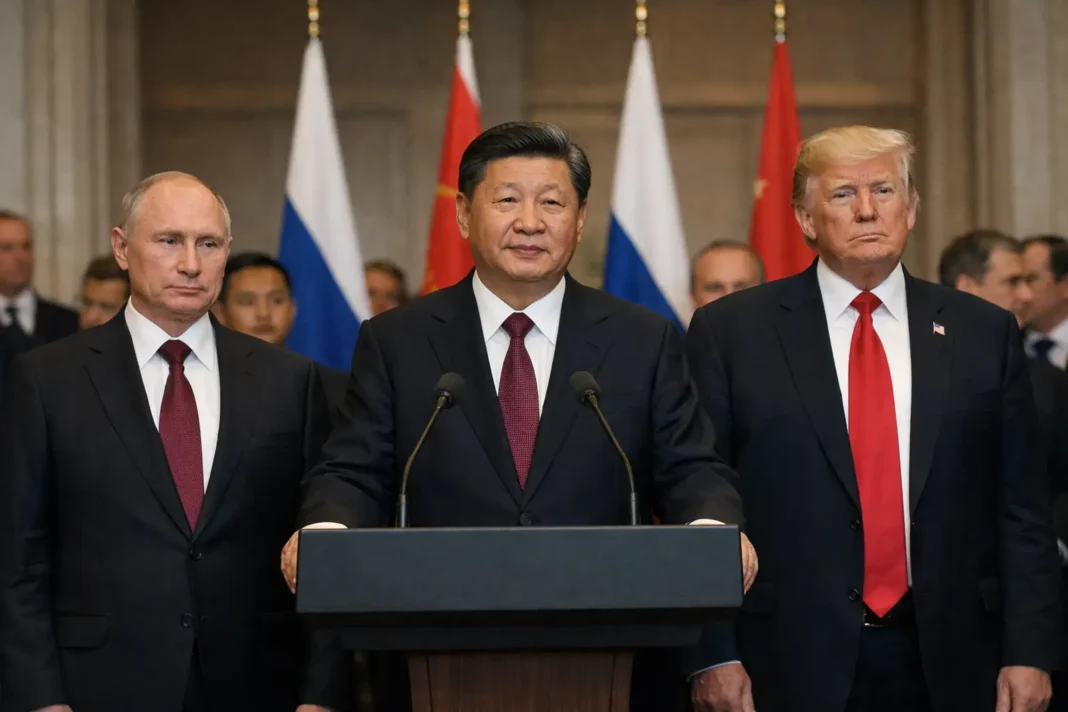

For Xi Jinping, the current diplomatic moment offers rare visibility on the world stage. A meeting involving Xi Jinping, Vladimir Putin and Donald Trump places the Chinese leader at the centre of a carefully watched international exchange, with implications for China, Russia and the United States. The encounter is notable not only because of the leaders involved, but because it highlights Beijing’s ambition to remain a central actor in global diplomacy.
The opportunity, however, is accompanied by constraints. The main challenge is not simply the symbolism of appearing alongside or engaging with Putin and Trump, but the management of subjects that Xi does not appear eager to address with either leader. In high-level diplomacy, what is left outside the conversation can be as politically significant as what is placed on the agenda. For Beijing, controlling the scope of discussion is part of preserving leverage and avoiding public exposure on sensitive issues.
China’s leadership, represented internationally through the Ministry of Foreign Affairs of the People’s Republic of China, has long sought to project stability and strategic autonomy. Engagement with Moscow, whose positions are communicated through the Kremlin, and with Washington, represented institutionally by the White House, requires a different diplomatic balance. Each relationship carries its own political weight, and each can affect how China is perceived by governments, markets and multilateral institutions.
For Putin, contact with Xi underscores the continued importance of the Russia-China channel. For Trump, any exchange with the Chinese president inevitably connects domestic political messaging with wider strategic competition. Xi’s position is therefore complex: he can benefit from appearing indispensable to both sides, but he also faces the risk that unresolved questions could dominate the narrative around the meeting. That risk is sharper when the subjects avoided are precisely the ones other capitals want clarified.
The significance of the moment lies in this tension between access and exposure. Xi gains from being seen as a leader whom major powers must engage, yet the same stage can narrow his room for manoeuvre. The outcome will depend less on ceremonial imagery than on whether the discussion avoids becoming defined by the issues Beijing would prefer to keep at a distance.






