
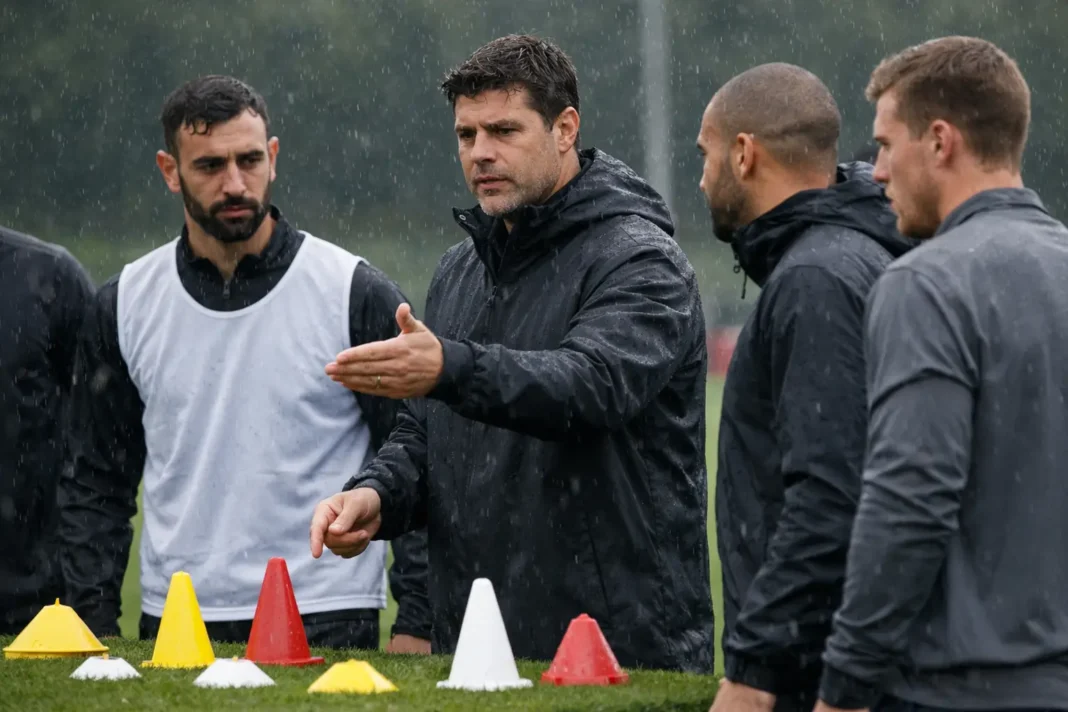

Mauricio Pochettino begins his Manchester United tenure with three immediate questions shaping the scale of the job: how to rebuild the dressing-room culture, how to make the team more secure without the ball, and how best to use Bruno Fernandes. For a club measured not only by results but by identity, the new head coach inherits a role in which performance, leadership and standards are inseparable.
The cultural challenge is the broadest and arguably the most important. At Manchester United, managers are judged on whether the team looks coherent as much as whether it wins. Pochettino’s reputation has been built on intensity, collective responsibility and clear tactical habits. Those principles now have to be translated into a squad that will be expected to show greater consistency in attitude and execution. Establishing authority quickly, while keeping influential players engaged, will be central to the early months of his management.
Defence is the most visible tactical priority. United’s ability to control matches depends on more than the back line; it requires compact spacing, coordinated pressing and midfield protection. Pochettino’s teams have often relied on energy and organisation to reduce the number of situations defenders must solve alone. At Old Trafford, that work will need to produce a side capable of resisting pressure, managing transitions and avoiding the open spaces that have so often left the team vulnerable in high-profile matches.
The role of Bruno Fernandes gives Pochettino another defining decision. The Portuguese midfielder remains one of United’s most creative and influential players, but his impact is closely linked to the structure around him. Used too freely, his risk-taking can stretch the team; used too rigidly, one of United’s main sources of invention can be diminished. Finding the right balance between freedom and discipline could determine whether Fernandes becomes the centre of a more stable attacking model or continues to carry too much responsibility in disjointed phases of play.
These priorities will unfold under the scrutiny that follows every major decision at one of English football’s most watched clubs. The Premier League offers little time for gradual adjustment, and Pochettino’s authority will be tested by results as well as by the clarity of his ideas. His first task is not simply to change personnel or tactics, but to give United a recognisable framework. Culture, defence and Fernandes are not separate issues; together, they will reveal whether this new era can develop a lasting direction.






