

By El Handouz Mohamed Abdellatif
There are moments in life when remaining silent is simply not an option. Moments when our humanity, our conscience, and our sense of responsibility call upon us to stand beside those who are suffering. The tragic events that struck Trappes and La Verrière are among those moments.
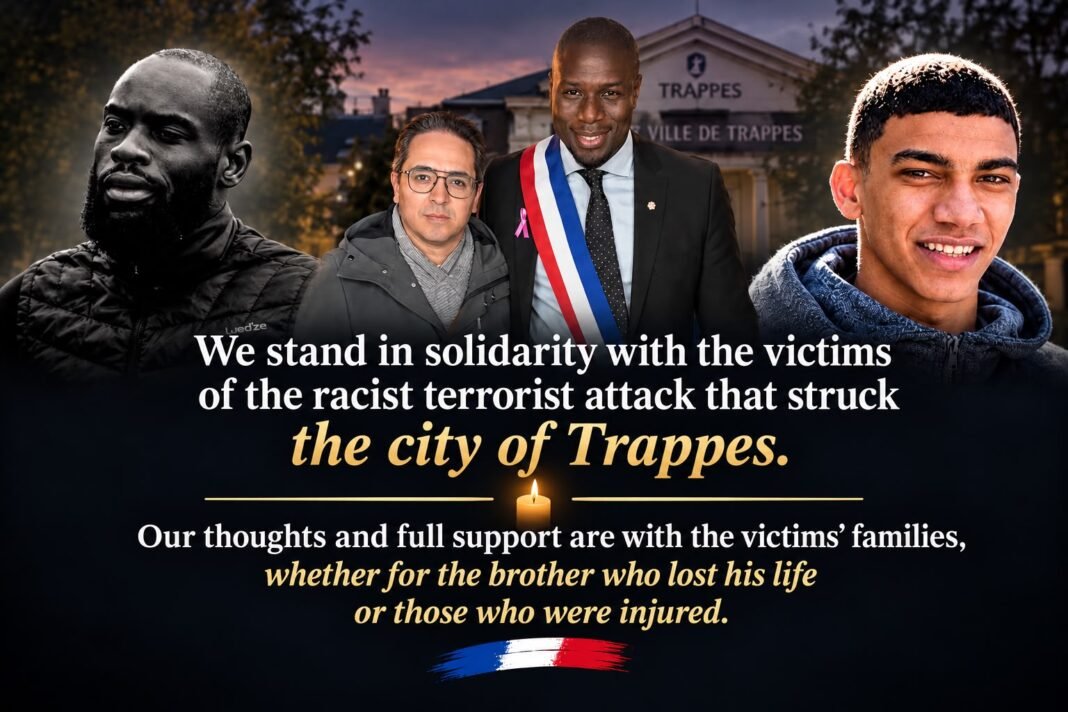
When Demba Traoré, Mayor of Le Blanc-Mesnil, called for a gathering in solidarity with the victims of this racist attack, I felt a profound moral obligation to be present. My decision was not motivated by political considerations or a desire for public recognition. It came from something much deeper: the conviction that when innocent people are targeted because of who they are, where they come from, or what they believe, their suffering becomes a concern for all of us. I could not remain indifferent. I could not accept that hatred and violence should be met with silence. My presence was a simple but sincere expression of solidarity, compassion, and commitment to the fundamental values that should unite us as human beings.
Human Dignity Must Never Be Negotiable
I have always believed that a society is judged not only by the principles it proclaims, but above all by the way it protects its most vulnerable members. Liberty, equality, and fraternity are not merely words engraved on the walls of our public institutions. They represent a moral responsibility, a collective promise, and a vision of society built upon respect for every human life. These principles are deeply rooted in the intellectual heritage of the Enlightenment and in the long history of struggles for justice, freedom, and human rights that helped shape the French Republic.
Yet their true meaning is revealed not through speeches or ceremonies, but through our actions when injustice occurs. What value does fraternity have if we turn away from someone else’s suffering? What meaning does equality carry if people continue to live in fear because of their origins, their skin colour, or their beliefs? Human dignity cannot depend on nationality, religion, appearance, or social background. It belongs equally to every person, without exception.
Racism Is Not Only an Attack on Its Victims, but on Society as a Whole
The violence that struck Trappes and La Verrière is a painful reminder that racism remains a reality against which we must continue to stand firmly and collectively. Behind every act of racist violence are human lives, families, memories, hopes, and dreams. There are parents, children, brothers, sisters, and loved ones whose lives can be changed forever by hatred. We must never allow such suffering to become an ordinary headline, another passing tragedy, or a statistic soon forgotten.
Racism is not simply an expression of prejudice. When it turns into violence, it destroys lives, spreads fear, fractures communities, and undermines the very foundations of peaceful coexistence. To condemn racism is therefore not enough. We must reject the attitudes, words, and behaviours that allow discrimination and hatred to take root. Our responsibility is to defend a society in which differences are never treated as threats, and where no one should have to justify their right to live in peace and dignity.
Standing with the Families, Sharing Their Pain
Today, my thoughts are first and foremost with the family of the man who lost his life, with those who were injured, and with everyone whose life has been affected by this tragedy. To the bereaved family, I extend my deepest and most sincere condolences. No words can truly ease the pain of losing a loved one, particularly under such painful circumstances. To the injured, I wish strength, courage, and a full recovery. To their families, I offer my heartfelt support and solidarity.
We cannot pretend to fully understand the depth of their suffering. But we can refuse to leave them alone in their grief. We can stand beside them, listen to them, respect their pain, and remind them through our presence and our actions that their lives matter and that their suffering will not be met with indifference. Solidarity does not erase grief, but it can help ensure that grief is not carried in isolation.
Our Presence Must Have Meaning Beyond the Gathering
By responding to the call for solidarity in Le Blanc-Mesnil, I wanted to affirm a simple conviction: our responsibility as citizens does not begin and end with public declarations. A gathering is important. It allows us to express our compassion, our indignation, and our shared determination to reject hatred. But its true significance depends on what we do afterwards.
We must continue to encourage dialogue between communities, promote mutual understanding, challenge prejudice, and defend equal treatment for every citizen. We must teach younger generations that diversity is not a weakness but a human reality that can enrich our common future. Above all, we must refuse to normalise racism, whether it appears through words, exclusion, humiliation, discrimination, or physical violence. Silence in the face of injustice risks allowing that injustice to continue. Our conscience demands more from us.
Fraternity Is a Responsibility We Share
My participation in this gathering was guided by my personal convictions and by my understanding of what citizenship should mean. Being a citizen is not simply a matter of belonging to a country or enjoying certain rights. It also means accepting responsibilities towards others, especially when their dignity, freedom, or security is threatened.
I believe in a France where people of different origins, cultures, and beliefs can live together without fear. A France faithful to its republican principles, where equality is not selective, fraternity is not conditional, and human dignity is never treated as a privilege reserved for some. This ideal requires courage, vigilance, and a willingness to act.
We must be capable of recognising the suffering of others even when their experiences differ from our own. We must defend justice not only when it concerns us personally, but also when it concerns people we may never have met. That is the true meaning of solidarity.
Against Hatred, Let Us Stand Together
The tragedy affecting Trappes and La Verrière should remind us of an essential truth: hatred divides, but humanity brings us together. We cannot bring back a life that has been lost. We cannot undo the suffering already inflicted. But we can choose how we respond. We can choose compassion over indifference, justice over prejudice, and fraternity over division.
Let our solidarity be more than a moment of emotion. Let it become a lasting commitment to defending human dignity, protecting one another, and building a society in which no person has to fear being targeted because of their identity. In the face of racism, our answer must be equality. In the face of violence, our answer must be justice. In the face of hatred, our answer must be fraternity. And in the face of human suffering, our answer must always be solidarity.
Because the dignity of one human being is inseparable from the dignity of us all. Racism has no place in our society, and defending human dignity must remain a responsibility shared by everyone.





