
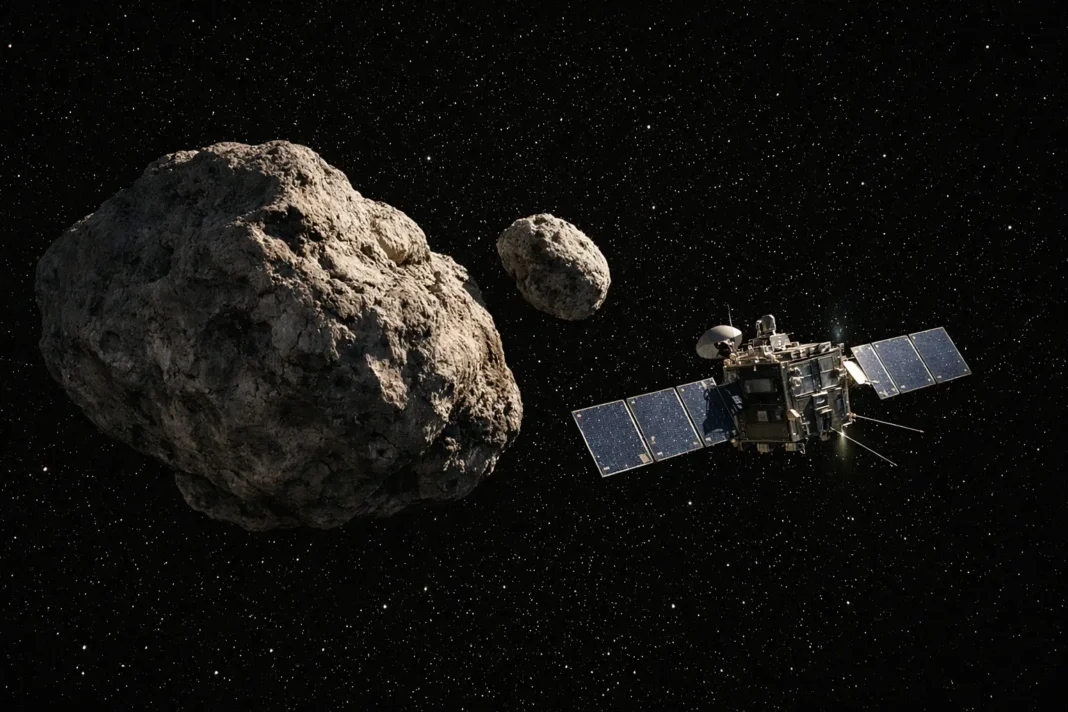

A European spacecraft has obtained its first clear view of the two asteroids at the centre of one of the most closely watched experiments in modern space science. The Hera mission, led by the European Space Agency, is now closing in on the pair struck during NASA’s 2022 attempt to test whether a spacecraft could alter the path of a potentially dangerous asteroid.
The American experiment marked the first real-world demonstration of a kinetic impact technique for planetary defense. NASA deliberately sent a spacecraft into the smaller body of a binary asteroid system, proving that a collision could shift an asteroid’s motion. The result was more pronounced than scientists had anticipated, leaving a central question unresolved: why did the target move so much more than expected after impact?
Hera is designed to answer that question by inspecting the aftermath at close range. Its approach will allow researchers to compare pre-impact expectations with the current state of the asteroid pair and assess the physical consequences of the collision. The mission’s observations are expected to help determine how the structure and behaviour of an asteroid influence the effectiveness of a deflection attempt, a key issue for any future response to a credible threat.
The first clear images are therefore more than a navigational milestone. They begin the second half of a joint scientific story that started with impact and now moves toward diagnosis. While the 2022 test showed that humanity can alter an asteroid’s trajectory, the European follow-up is intended to turn that demonstration into usable knowledge. The findings could refine how future missions are planned, particularly if decision-makers ever need to evaluate the best way to move a hazardous object away from Earth.





