
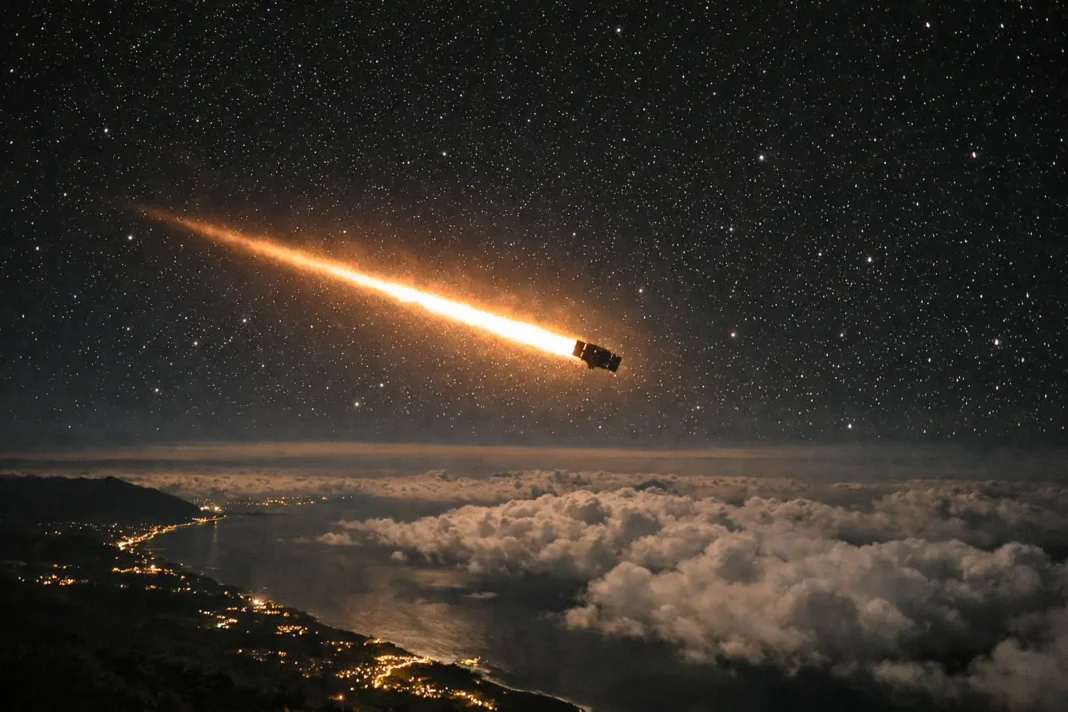

NASA’s Swift observatory has ended its mission in a fiery descent over Indonesia, closing one of the most durable chapters in modern space astronomy. The spacecraft reentered Earth’s atmosphere at 7:39 a.m. EST on Wednesday above the North Sumatra region, near 3.4 degrees north latitude and 98.6 degrees east longitude. NASA expected most of the observatory to disintegrate during reentry and had estimated a 1-in-2,100 chance that any surviving debris could fall over a populated area. No injuries or damage have been reported.
Launched in November 2004, the spacecraft — formally named the Neil Gehrels Swift Observatory — was built for a two-year assignment but remained scientifically productive for almost 22 years. Weighing about 3,200 pounds, or 1,450 kilograms, Swift was created to detect gamma-ray bursts, among the most energetic explosions known in the universe. Its role soon expanded, making it a key instrument for observing supernovas, black holes and other rapidly changing events that require immediate follow-up from orbit.
Swift’s importance came from speed as much as sensitivity. The observatory carried three telescopes capable of studying targets in ultraviolet, optical and X-ray light, allowing scientists to examine the same event across several wavelengths. It could turn toward a new source within minutes, a capability that helped researchers capture short-lived signals before they faded. NASA credits the mission’s observations with contributing to roughly 7,000 research papers, leaving an archive that will remain useful to astronomers long after the spacecraft’s destruction.
The end was driven by orbital decay. Atmospheric drag gradually slowed Swift, causing it to sink closer to Earth, while increased solar activity made the upper atmosphere expand and intensified that drag. NASA formally ended scientific operations on Oct. 20, after the declining altitude made observations too difficult. Earlier in 2026, a rescue attempt had been planned using a privately developed robotic spacecraft from Katalyst Space Technologies to rendezvous with Swift and raise it to a safer orbit. The mission failed after launch, leaving the observatory on course for reentry.
Swift’s loss removes an unusually responsive platform from the global astronomy network, particularly for the study of gamma-ray bursts, whose brief signals can reveal extreme physics across vast cosmic distances. Its long performance also underscores a recurring feature of space science: missions designed with modest lifetimes can become foundational when their instruments remain reliable and their data address questions far beyond the original plan.





