
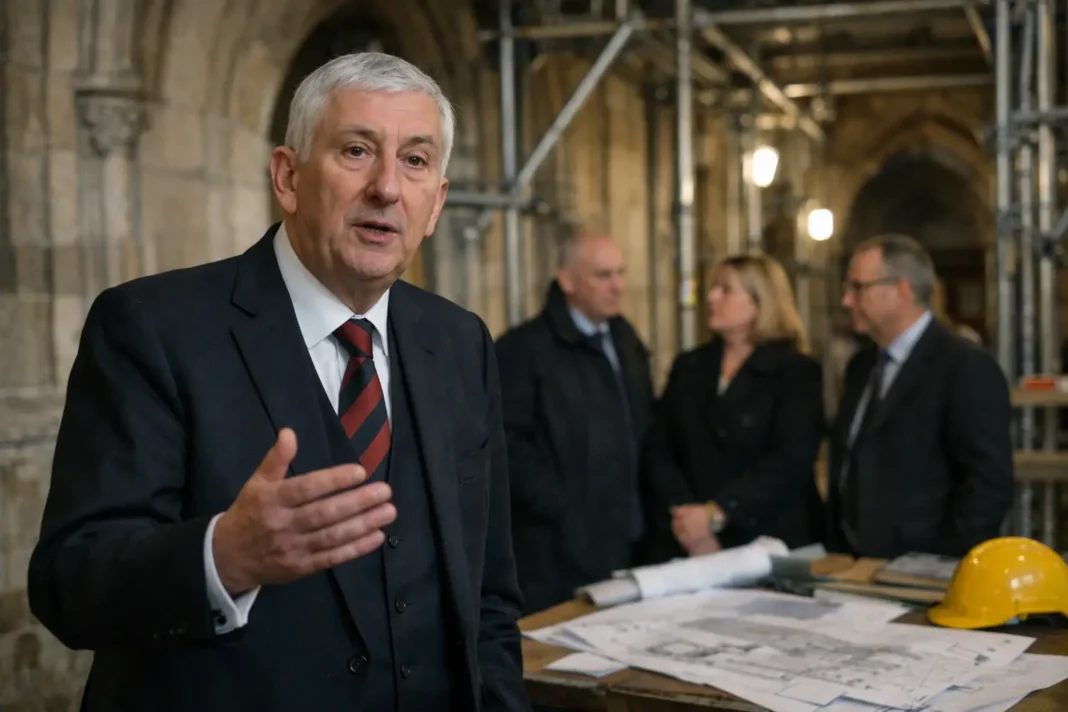

Delays to Parliament’s restoration have drawn a renewed warning from Sir Lindsay Hoyle, who has described the slow progress as frustrating and called for action after a parliamentary committee said it was “crunch time” for the ageing building. The intervention places fresh attention on the long-running effort to repair and modernise the Palace of Westminster, the home of the UK Parliament.
The issue is not limited to routine maintenance. Westminster is both a working legislature and a historic national landmark, used daily by MPs, peers, staff, journalists and visitors. The restoration programme has therefore become a test of how the United Kingdom manages a landmark institution while preserving parliamentary business. For years, plans have had to balance safety, heritage protection, cost control and the practical demands of keeping democratic proceedings in operation.
The committee’s warning that the project has reached a decisive moment underlines concern that postponement increases pressure on the estate and leaves key decisions unresolved. Sir Lindsay’s comments add institutional weight to those concerns. As Speaker of the House of Commons, he is responsible for chairing Commons proceedings and represents one of the most visible offices within UK politics. His call for movement signals that the condition of Parliament is no longer only a technical matter for project boards, but a question affecting the credibility and functioning of the legislature itself.
The Palace of Westminster presents unusual challenges because any major work must take place in a complex, secure and symbolically sensitive environment. Decisions on how and when to proceed have consequences beyond construction timetables. They affect parliamentary access, public confidence, long-term value for taxpayers and the protection of a building closely associated with British constitutional life. The longer the process remains unsettled, the harder it becomes to separate unavoidable complexity from avoidable delay.
The latest warning does not settle the central questions facing the restoration programme, but it sharpens the political pressure around them. Parliament must now determine how to move from repeated recognition of the building’s problems to concrete action. For an institution that scrutinises government decisions every day, the handling of its own home has become a visible measure of its capacity to plan, prioritise and deliver.






