
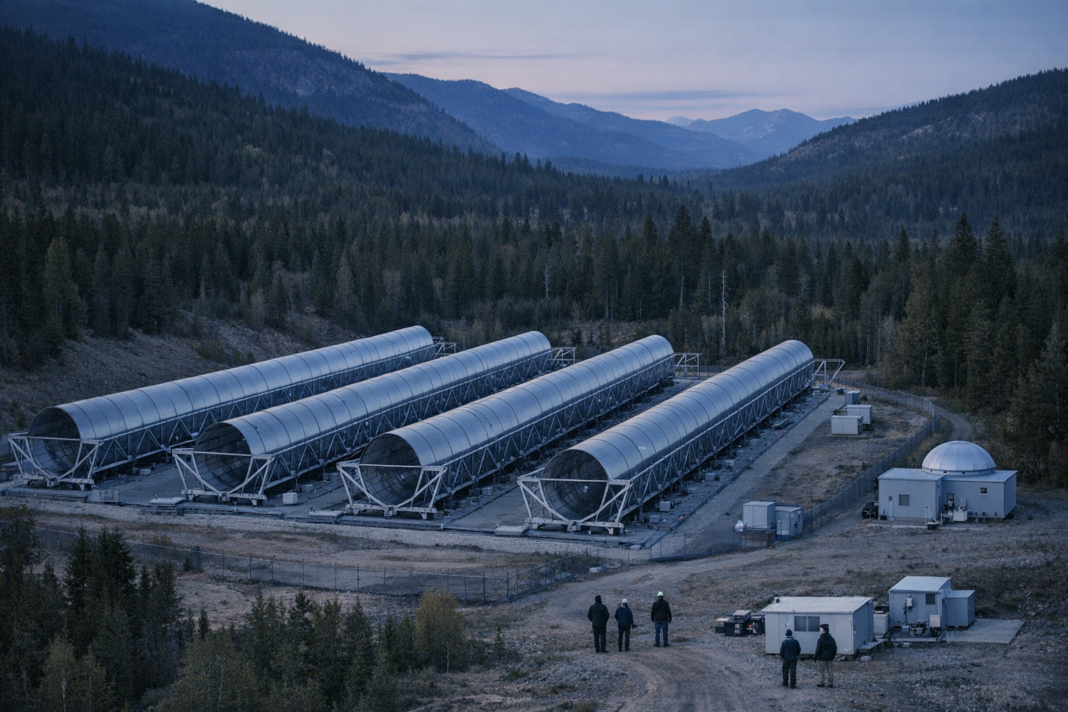

CHIME achieves first independent detection of distant cosmic hydrogen, a milestone that could expand how astronomers trace the universe’s accelerating expansion. A study published Sept. 28 in The Astrophysical Journal reports that the Canadian Hydrogen Intensity Mapping Experiment proved capable of mapping faint radio emission from hydrogen using only its own observations.
The effort, drawn from 94 nights of data collected in 2019 and vetted across a seven-year validation process, demonstrates that CHIME—a radio array near Penticton, British Columbia that surveys the northern sky daily—can detect signals originating as far back as roughly three billion years after the Big Bang. Study authors emphasise that establishing an internal, self-consistent measurement was essential because CHIME previously relied on external telescopes to confirm its results, a confirmation step that adds cost and complexity to large-scale surveys.
Lead contributors to the papers include postdoctoral researchers Arnab Chakraborty of the University of Toronto and Shabbir Shaikh of Arizona State University, who note that the new analysis aligns broadly with prior measurements. An accompanying paper published alongside the main result finds that about 2% of hydrogen in the surveyed volume exists in a neutral atomic state, a figure consistent with other observational programs and an important input for models that link gas distribution to cosmic structure growth.
The demonstration that CHIME can operate as a standalone instrument carries practical and scientific implications. By producing cost-effective, repeatable maps of hydrogen over large sky areas, the array provides an independent tracer of matter distribution across cosmic time. That tracer can be used in future studies to examine how the rate of expansion has changed and to add complementary constraints on the phenomena driving accelerated expansion. The CHIME team plans to apply the validated methodology to the instrument’s remaining years of data to refine measurements and extend the temporal reach of the hydrogen maps.





