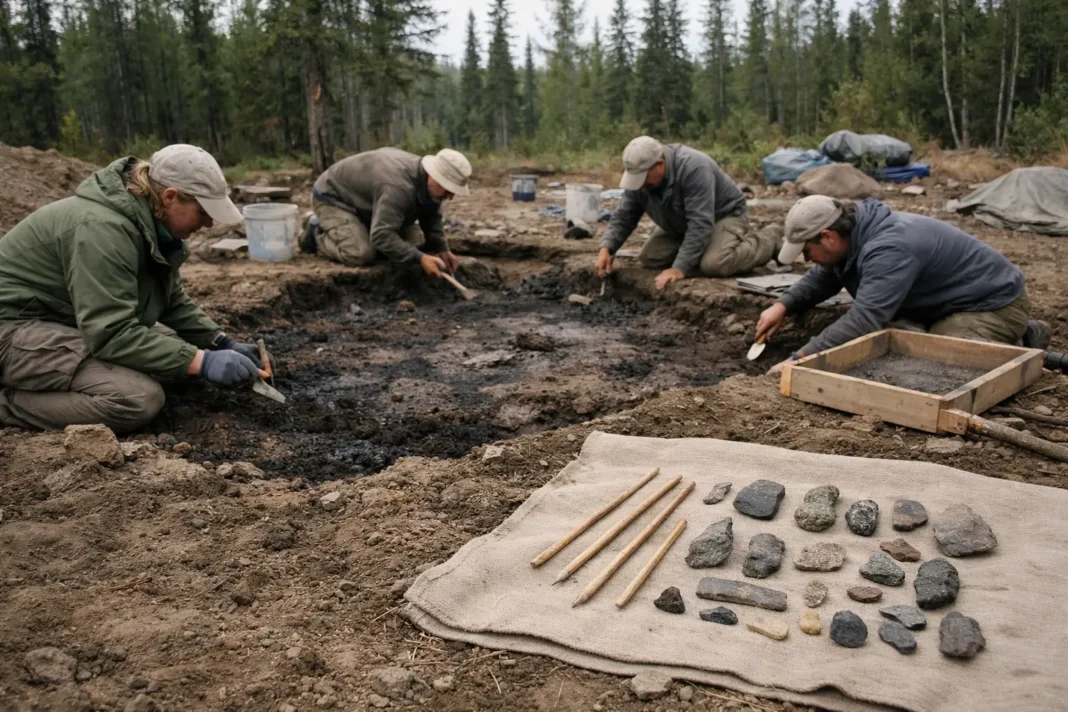

Archaeologists have uncovered a dense, long-occupied encampment at Shégˊ Xdaltthˊíˊ, a site in interior Alaska dated to about 13,800 years ago. Excavations southeast of Fairbanks produced thousands of artifacts and faunal remains that include a hearth, structural features consistent with a tent or lean-to, and an earth oven filled with charcoal and animal bone. The assemblage also contains tiny bone needles and a worked antler pendant, evidence of domestic and technological practices rarely preserved this far north so early in the continent’s prehistory.
The findings, described in Science Advances, point to a degree of residential stability at the site not previously documented so early in the Western Hemisphere. Excavators recovered stone tools — notably diamond-shaped hafted bifaces made from rhyolite and basalt — and obsidian pieces traced to a volcanic source hundreds of miles to the northwest. The variety and concentration of artifacts suggest repeated or prolonged occupation rather than a brief hunting camp, and the bone needles represent the oldest eyed sewing implements yet found in the Americas.
Faunal evidence includes the remains of more than a dozen wolf-like animals. Analyses indicate these canids were not dire wolves or typical Pleistocene gray wolves but a population characteristic of central Alaska, reinforcing biological and cultural ties to Asian Beringia. The tool forms and raw-material sources show links across the northern Pacific into what is now Siberia, while items such as the antler pendant and the sewing kit components have parallels with early sites farther south of the former ice sheets. Project lead Kelly Graf (University of Kansas) framed the assemblage as one that illuminates both local lifeways and broader interregional connections.
Specialists not involved in the fieldwork have emphasized the site’s significance for models of the peopling of the Americas. Spencer Pelton of the University of Wyoming noted that discoveries in Beringian contexts are central to resolving early migration and settlement patterns. The excavation team plans further work in the area and has involved elders from nearby Alaska Native corporations; those elders helped name the site and have contributed local knowledge to guide future investigations. Researchers say additional Beringian fieldwork will be key to placing Shégˊ Xdaltthˊíˊ in a wider continental picture of early human residence and mobility.